

How One Captain Completely Changed My Perspective on Cabin Crew

Updated: Aug 18
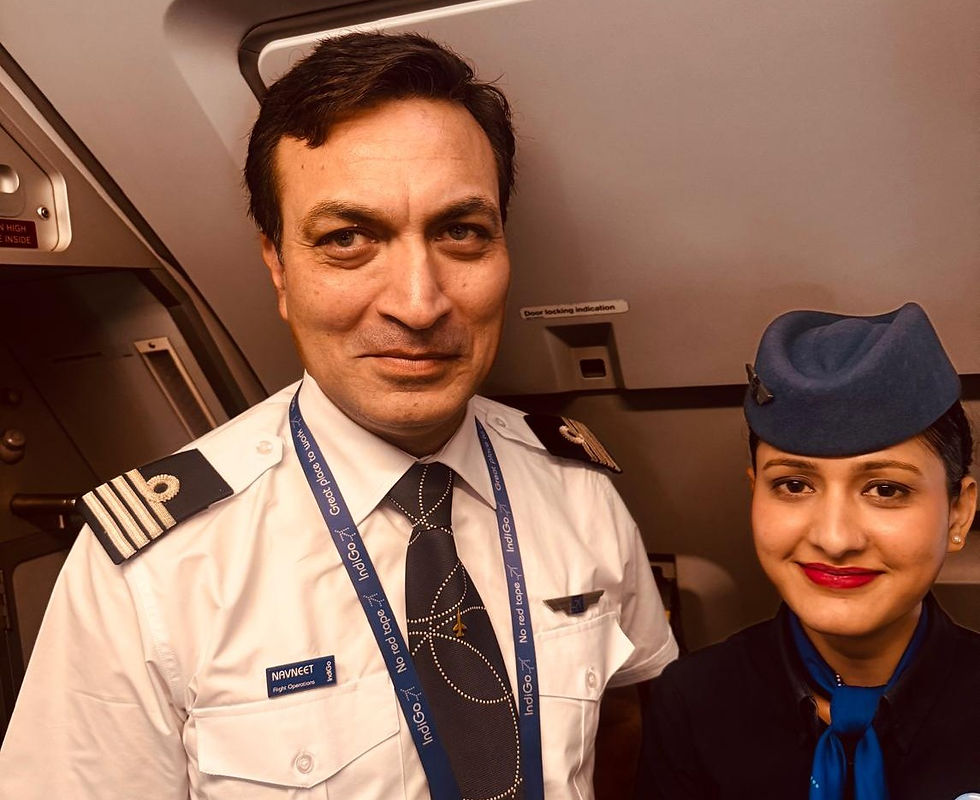
It was a lovely afternoon on June 17, 2025. I was boarding IndiGo flight 6E 2131 from Delhi to Ahmedabad alongside a colleague. Less than a week prior, a tragic aviation accident had occurred during a takeoff, so like many passengers that day, a safe flight was top of mind.
I’ve been flying for over 55 years. I always pay attention to the safety announcements, but if I’m being honest, I usually tune out when the Captain comes on the PA system. It’s almost always the same: flight time, weather updates, and standard pleasantries.
But on this day, the announcement was brilliant. It caught my attention instantly.
The man in the cockpit was Group Captain (Retd.) Navneet Raina, an ex-Indian Air Force officer. What he did next was a masterclass in leadership, respect, and applied psychology.
The Reality of Being Cabin Crew
As an avid observer of human behaviour, I’ve noticed a troubling trend over my five decades of flying. Many passengers treat young cabin crew members with a sense of disdain or superiority. They are often viewed merely as "servers" or "pretty faces in uniform."
Because passengers pay for their tickets, an unfortunate sense of entitlement often kicks in. We see it all the time:
Passengers ignoring instructions to switch off mobiles.
People walking around while the seatbelt sign is glaringly lit during turbulence.
A near-total lack of appreciation. When deboarding, the crew smiles and bids everyone goodbye, yet most passengers won't even return a smile, let alone a "thank you."
It is a tough, high-stakes, and often thankless job. Their primary role isn't just serving tea and coffee; they are rigorously trained safety professionals. In an emergency, their split-second decisions are quite literally the difference between life and death.
The Announcement That Changed Everything
After the usual welcome, Captain Raina did something unique. He introduced each cabin crew member by name. Then, he delivered a line I had never heard in 50 years of flying:
"Our cabin crew has undergone extensive and rigorous training. They are experts here to ensure your safety during this flight. Please follow their instructions at all times to ensure your safety, the safety of your fellow passengers, and the safety of this aircraft."
What made this simple announcement so powerful? It perfectly invoked Dr. Robert Cialdini’s psychological Principle of Authority. The principle states: People tend to follow the lead of credible and authoritative figures. Recommendations from experts or individuals with credentials enhance trust.
[ Traditional View ] ──> Cabin Crew = Service Staff
│
(Captain's Announcement)
▼
[ Psych. Shift ] ──> Cabin Crew = Safety Experts
Elevating "In Authority" (In Uniform) to “An Authority” (Expert)
We subconsciously defer to people who wear uniforms—it gives them a baseline level of authority. But Captain Raina’s words did something deeper: He elevated his crew from being in authority to being an authority.
By explicitly labelling them as "trained safety experts," he shifted the power dynamic in the cabin. They were no longer just young women serving drinks; they were the qualified professionals protecting our lives.
As I disembarked, I asked to meet Captain Raina. I wanted to personally compliment him on using such a seamless, elegant method to drive passenger compliance. By lending them his own credibility, he ensured his crew would be respected rather than ignored or dismissed.
💡 The Corporate Takeaway
As leaders, how often do we fail to build up our team members in front of clients or stakeholders?
True leadership isn't just about wielding your own authority; it’s about transferring your authority to empower your team. When you publicly validate your team's expertise, you change how the world treats them.


Comments